


Variable Area Flowmeter Gas Correction Factors

To determine corrected flowrate: find the gas for which the meter is calibrated in the left column, move to the right to the gas that is being used. Multiply the flowrate indicated on the flowmeter by the correction factor. This will equal an approximation of the flow rate of the gas being used.

Please note: this correction factor is only accurate within ±10%. This is also inaccurate for extremely low flow, or elevated pressure.

Correction factors should not be used for variable are flowmeters with ball floats.

Consult Applications Engineering for your specific condition.

Gas being used / S.G.
Gas for which meter is calibrated H₂ Cracked
Ammonia
Methane Ammonia Gas Neon Acetylene N₂ or O₂ Air Ethane O₂ Argon CO₂ or N₂O Propane Butane
  0.070 0.294 0.554 0.588 0.620 0.700 0.899 0.967 1.00 1.038 1.105 1.105 1.520 1.523 2.007
Air 3.78 1.84 1.34 1.30 1.27 1.20 1.05 1.02 1 0.98 0.95 0.95 0.81 0.81 0.71
Oxygen 3.97 1.94 1.41 1.37 1.34 1.26 1.11 1.07 1.05 1.03 1 0.90 0.85 0.85 0.74

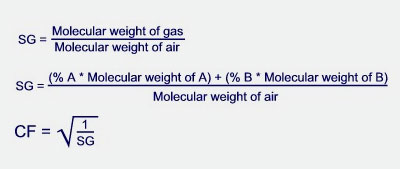
Calculating a Gas Correction Factor

Based on Specific Gravity

calculating-conversion-factors

Pressure & Temperature Corrections

Pressure Effects

  • Elevated pressures (above atmosphere) allow for greater capacity for a given flowmeter
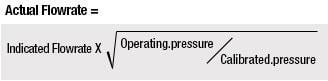
  • To determine the actual flowrate (at the elevated pressure), the following formula is used:
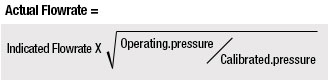
pressure-effects-actual-flowrate

  • All pressures are in absolute, not gauge
Temperature Effects

  • Elevated temperatures (above standard atmospheric temperature) decrease maximum flow rate for a given flow body
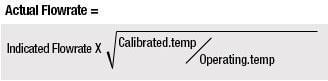
  • To determine the actual flow rate, the following formula is used:
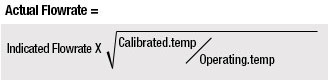
temperature-effects-actual-flowrate

  • All temperatures are in absolute
Pressure Correction Example

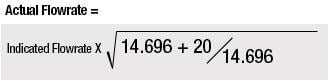
  • Our flowmeters are calibrated at a standard pressure of 14.696 PSIA (which is equivalent to 0 PSIG)
  • If a customer is operating the meter at 20 PSIG, what will the effect be on the flow reading?
  • The actual flowrate will be higher thanthat indicated by the flowmeter
  • How much higher will it be?
pressure-correction-example
pressure-correction-example-2

Actual flowrate = Indicated Flowrate x 1.5365

Temperature Correction Example

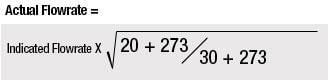
  • Our flowmeters are calibrated at a standard temperature of 20 °C or 68 °F
  • If a customer is using the meter at 30 °C, what will the effect be on the flow reading?
  • The actual flowrate will be lower thanthat indicated by the flowmeter
  • How much lower will it be?

temperature-correction-example
temperature-correction-example-2

Actual Flowrate = Indicated Flowrate x .9834

Discover What’s Possible with Brooks Instrument

Ready to find the right solution? Our experts are here to guide you. Explore products, request support, or connect with a distributor today.