



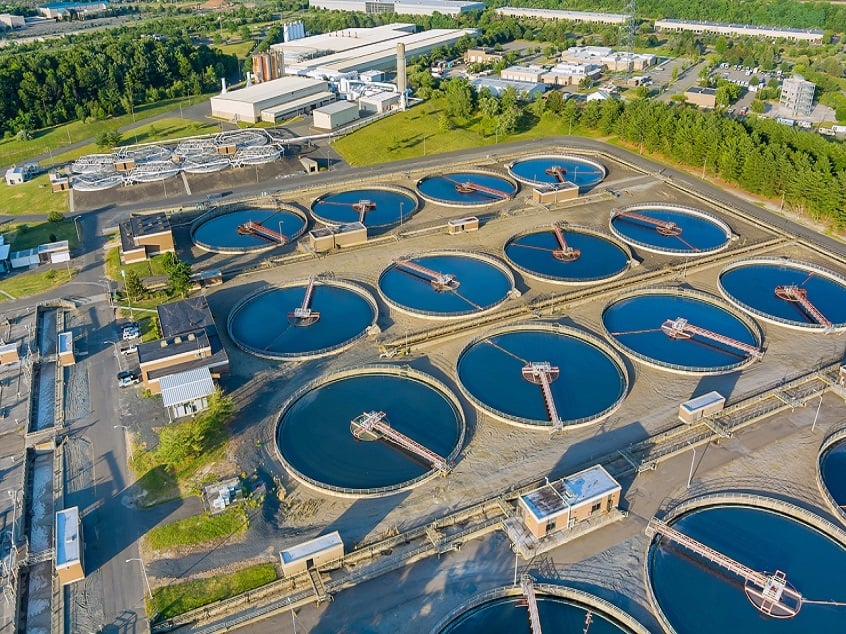
Wastewater streams often contain harmful bacteria, pathogens, and suspended solids that require controlled treatment and disinfection. Maintaining consistent process performance in wastewater treatment plants depends on accurate monitoring - making reliable flow measurement a critical component of system control.
While these processes are essential in every wastewater system, aging infrastructure can make maintaining reliable performance increasingly difficult. Many municipalities are now facing the challenge of upgrading systems that were built decades ago - where failures can lead to environmental contamination and public health risks.
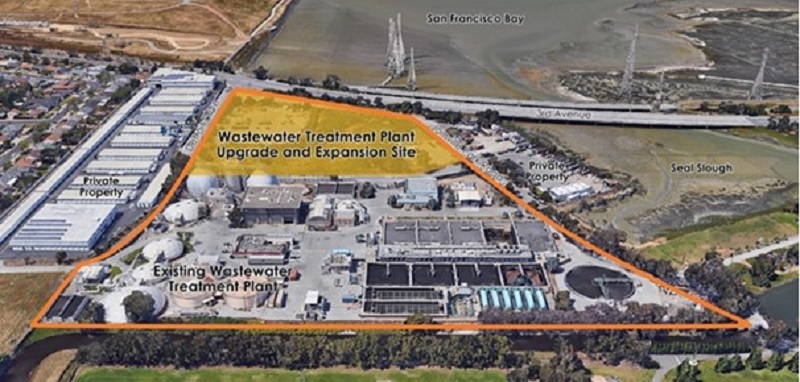
Photo Courtesy of City of San Mateo, California
Aging Wastewater Infrastructure in the San Francisco Bay Area
The San Francisco Bay area is currently depending on an aging sewage system and wastewater treatment infrastructure. Typically, sewer pipes have an average lifespan of 50-60 years; however, many of the pipes in the Bay area were constructed between 1900-1960, placing them barely within their useful lifespan. Additionally, the infrastructure is prone to failures including sanitary sewer overflows that leak diluted raw sewage and pollutants onto communities’ streets and into creeks, beaches, and the Bay causing public health and environmental concerns.
Recently, $1 billion was invested on a 10-year capital improvement infrastructure initiative known as the Clean Water Program. The program will support the San Francisco Bay area’s growing population of approximately 170,000 residents by repairing, replacing, and upgrading sewer conveyance including the building of a new wastewater treatment plant. More specifically, wet weather sewer capacity assurance will be built to prevent any overflows. Finally, the wastewater treatment plant will also abide by current and future regulatory requirements.
One significant component of a wastewater treatment plant is submersible pumps, which maintain flow throughout the piping system. These pumps use protective seals to prevent leakage as their shafts rotate at high speeds. According to Pumps & Systems’ Jussi Sorvoja, each seal type has specific seal water flow and pressure requirements—if exceeded, system failures may occur. Only a minimal amount of seal water is needed to cool and lubricate the seals and rotating shaft while flushing out impurities.
Because of these precise operating conditions, maintaining proper flow measurement is critical to ensuring reliable pump performance.
Application Requirements
To support submersible pump operation, flow measurement devices must provide accurate, repeatable readings at low flow rates in wastewater applications. They must also operate reliably in demanding environments while helping operators maintain proper seal water flow and pressure within specified limits. In addition, instrumentation should be easy to maintain, resistant to corrosion, and provide clear, real-time visual indication of flow conditions.
In many wastewater systems, seal water is often overused, leading to unnecessary water consumption and increased operating costs. To address this, operators require a reliable way to monitor and control both flow and pressure. Variable area flow meters, such as rotameters, provide a simple and effective solution by offering visual flow indication and adjustable control. As noted by Pumps & Systems’ Jussi Sorvoja, “Compared with unmetered systems, flow meters can reduce seal water use in systems by up to 90 percent. They also help seals perform at their peak by maintaining proper seal water pressure and flow.”
Oftentimes, systems consume too much seal water resulting in costly water consumption. In an effort to control seal water and pressure, variable area rotameters are utilized due to their valves and metering tubes as these adjustable features show the flow readings of the seal water. Jussi Sorvia also mentions, “Compared with unmetered systems, flow meters can reduce seal water use in systems by up to 90 percent. They also help seals perform at their peak by maintaining proper seal water pressure and flow.”
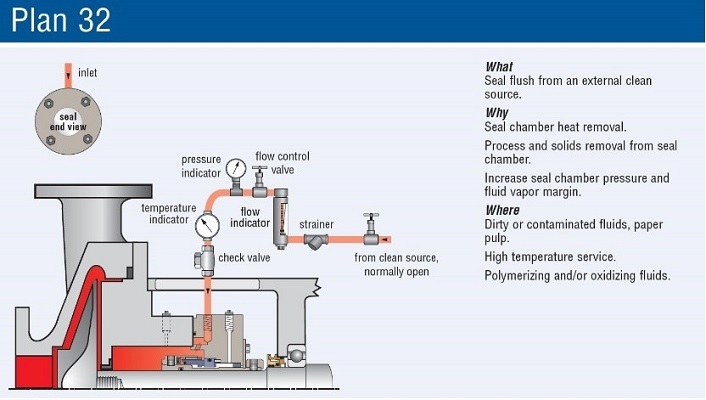
Drawing courtesy of Flowserve depicting a general schematic of seal pump systems.
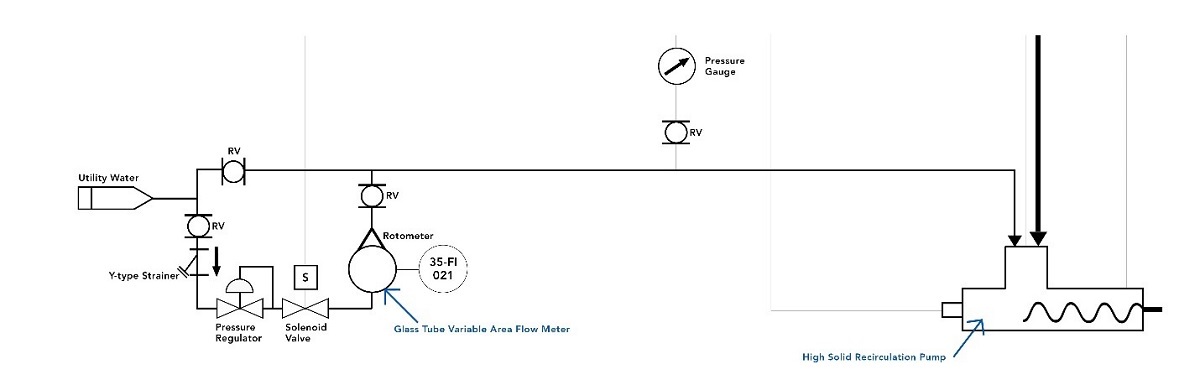
Glass Tube Variable Area Flow Meter in flow scheme
Process Solution: Optimizing Seal Water Flow with Variable Area Flow Meters
To support the Clean Water Program, a control system integrator partnered with Ponton Industries to identify a reliable solution for managing seal water flow across eleven submersible pumps. Each pump required precise flow measurement to maintain proper seal performance while minimizing water consumption.
Based on these requirements, Ponton Industries recommended the Brooks Instrument GT1600 Series variable area flow meter, a solution designed to provide accurate, visual flow indication without the need for external power.
Instrumentation Highlights
- Adjustable scale to compensate for variations in seal water flow and pressure
- Viewing window of the glass tube can be rotated at 360° and 180° to easily monitor the flow process
- Save money on seal water with integral valves and metering tube
- Avoid utility expenses as no power source is required
- Maintain the seals on the pumps due to seal water application, when necessary
Watch this GT1600 Series features video to learn more:
Upon completion, the upgraded wastewater treatment plant is expected to process up to 12 million gallons per day during summer months and handle peak flows up to eight times higher during wet weather events.
While flow meters may represent a small component of the overall system, they play a critical role in wastewater treatment operations. By enabling precise flow measurement of seal water, these instruments help reduce operating costs, conserve water, and protect critical equipment - ensuring long-term reliability of wastewater treatment operations.
.png?width=846&height=564&name=MFC-Accuracy-Cover%20(1).png)