





Mass flow controllers (MFCs) precisely measure and control the flow of gases in applications ranging from bioprocessing and semiconductor manufacturing to industrial research and production. While many specifications influence MFC performance, one of the most important—and often misunderstood—is turndown ratio. Understanding how turndown ratio relates to usable operating range can help you select the right controller for today's process while providing flexibility for tomorrow's requirements.
What is Turndown Ratio?
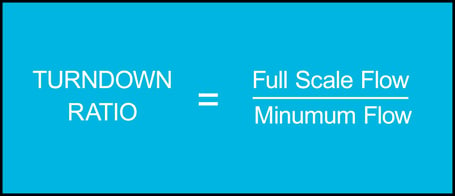
Turndown ratio is the ratio between the maximum and minimum flow rates a mass flow controller (MFC) can accurately measure and control. Simply put, it defines the range of flow rates a single instrument can handle while maintaining its specified performance.
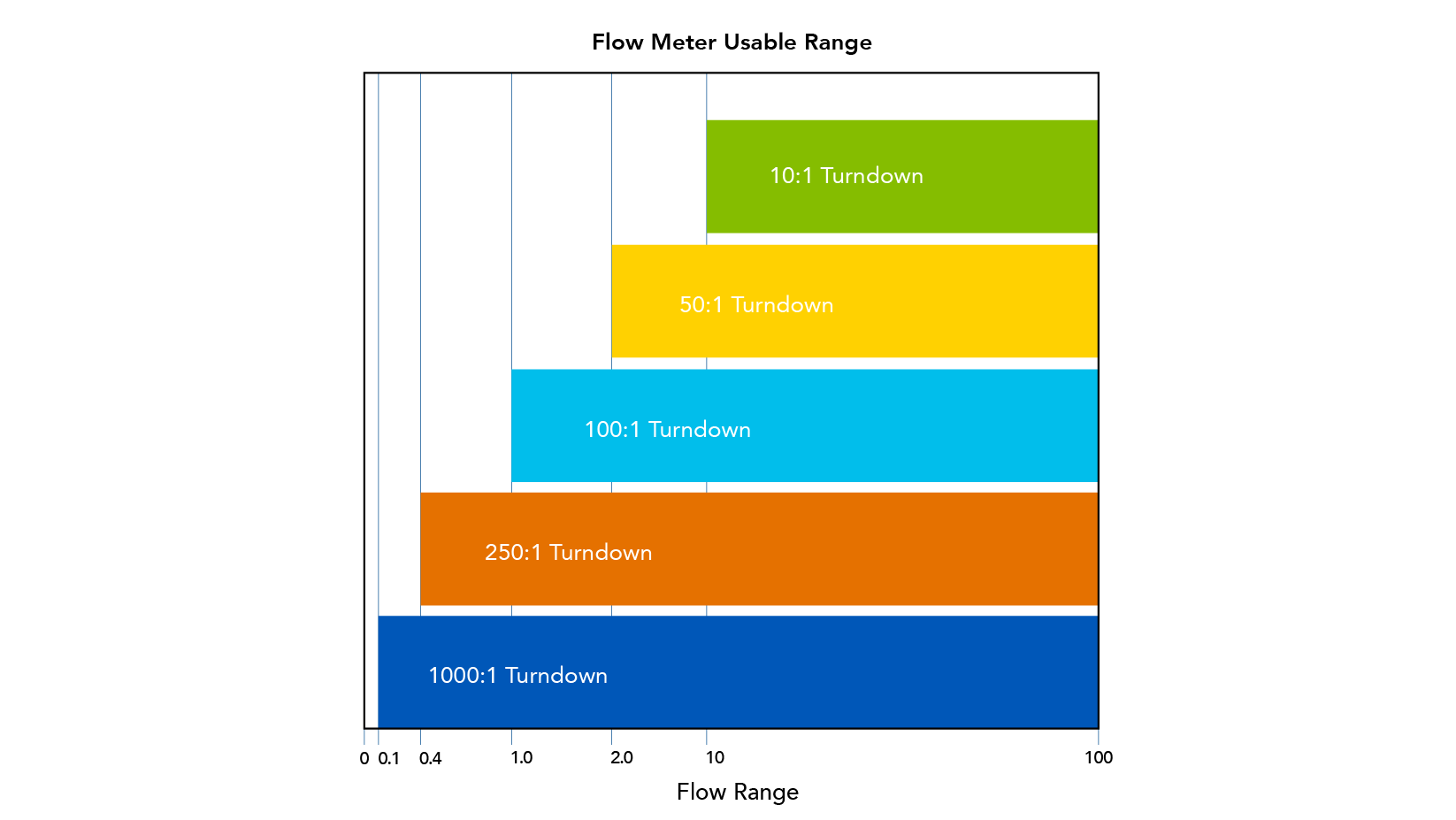
For example, a mass flow controller with a 100:1 turndown ratio can accurately control flows from 1% to 100% of its full-scale flow rate. A 250:1 turndown ratio extends that usable operating range even further, while a 1000:1 turndown ratio allows one controller to accommodate an even broader range of process conditions.
A higher turndown ratio provides greater flexibility by allowing a single mass flow controller to support multiple operating conditions that might otherwise require several instruments with different full-scale ranges. This can simplify system design, reduce spare inventory, and provide greater flexibility as process requirements evolve.
However, a published turndown ratio tells only part of the story. To understand how much of that range can be used in a real application, it's important to distinguish between turndown ratio and usable range.
Turndown Ratio vs. Usable Range
Although they're often used interchangeably, turndown ratio and usable range are not the same thing.
A mass flow controller's turndown ratio is a published specification that defines the theoretical range over which the instrument can accurately measure and control flow. However, the usable range is the range from the maximum measurable flow rate of the device, also known as the full scale range, to the minimum that provides good meaningful results for the process.
In practice, usable range depends on much more than the turndown ratio alone. Factors such as control valve performance, measurement accuracy, process pressure, gas properties, system dynamics, and application requirements all influence how much of the specified range can be used while maintaining stable, repeatable flow control.
For example, two mass flow controllers may both advertise the same turndown ratio, yet one may provide a wider usable operating range because of superior control performance and stability. That's why engineers should evaluate turndown ratio as one part of an instrument's overall performance—not as the only indicator of flexibility.
One of the key factors influencing usable range is the control valve itself. The valve must be able to make stable, repeatable adjustments across the instrument's operating range. As flow rates become very low, maintaining precise control becomes increasingly challenging. That's why a published turndown ratio alone doesn't guarantee usable performance—the quality of the valve design and control system plays a significant role in determining how much of that range can be used in practice.
Why Turndown Ratio Matters
Choosing a mass flow controller with the right turndown ratio isn't just about meeting today's flow requirements—it's about building flexibility into your process.
Flow requirements often change over the life of a system. During process development, pilot production, recipe optimization, or future expansion, a higher turndown ratio allows a single mass flow controller to accurately control a wider range of flow rates. This can reduce the need to replace instruments or maintain multiple controllers with different full-scale ranges, simplifying system design and reducing spare inventory.
Imagine owning a car capable of traveling 200 mph. On congested city streets, you'll rarely have the opportunity to use its full capability because of traffic, intersections, and speed limits. Take that same car onto Germany's Autobahn, however, and you have much greater opportunity to take advantage of its performance.
A mass flow controller works in much the same way. Its published turndown ratio defines its rated capability, but the usable operating range depends on the conditions in which it's used. Factors such as process requirements, gas properties, pressure conditions, control valve performance, and accuracy requirements determine how much of that theoretical range can be used in practice.
For this reason, turndown ratio should be considered alongside the other performance characteristics that determine how well an instrument will perform in your application. Understanding the relationship between turndown ratio and usable range helps ensure you select a mass flow controller that delivers reliable performance today while providing the flexibility to support future process changes.
The following animation illustrates how increasing turndown expands the usable operating range of a mass flow controller and enables greater process flexibility.
Looking Beyond the Published Turndown Ratio
A published turndown ratio can be a useful starting point when comparing mass flow controllers, but it shouldn't be the only specification you evaluate.
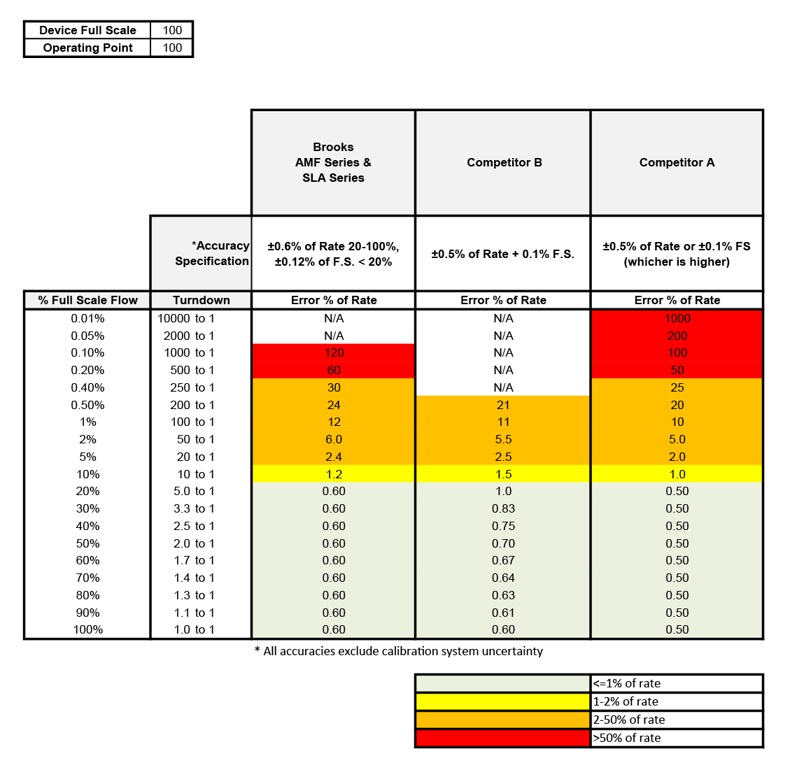
Some manufacturers advertise exceptionally high turndown ratios, making it appear that a single instrument can accurately control an extremely wide range of flow rates. However, a closer look at the published performance specifications often reveals that measurement accuracy degrades significantly at the lowest flow rates. While the controller may technically operate over that entire range, the portion of the range that delivers the accuracy and control performance your process requires may be considerably smaller.
This is why it's important to evaluate accuracy and turndown ratio together. An instrument with a lower published turndown ratio that maintains consistent accuracy across a broad operating range may provide greater real-world value than one with a much larger headline specification but reduced performance at the extremes.
The comparison below illustrates this concept. While one manufacturer advertises a substantially higher turndown ratio, the published accuracy specification changes significantly at the lowest flow rates. By comparison, Brooks high-turndown mass flow controllers are designed to maintain excellent measurement and control performance across a wide usable operating range, giving engineers greater confidence that the instrument will perform where it matters most.
Ultimately, the goal isn't to select the mass flow controller with the largest published turndown ratio—it's to select the one that provides the usable operating range your application requires while maintaining the accuracy, stability, and repeatability needed for reliable process control.
Choosing the Right Turndown Ratio
There is no single "best" turndown ratio for every application. The right choice depends on your process requirements, expected operating range, and how much flexibility you need as those requirements evolve.
For applications with stable operating conditions and a well-defined flow range, a conventional mass flow controller may provide the performance you need. However, processes involving development where flow requirements aren't fully defined, pilot plants scaling toward production, multiple recipes, or skids designed for future expansion often benefit from a higher turndown ratio, allowing a single instrument to accurately control a broader range of flow rates.
When evaluating mass flow controllers, look beyond the published turndown ratio. Consider how the instrument maintains accuracy, stability, and control performance throughout its operating range, and whether that range aligns with the flow rates your application will actually use.
Selecting the right mass flow controller means balancing capability with performance. A higher published specification only delivers value if it translates into a wider usable operating range for your process.
Brooks High-Turndown Solutions
Brooks Instrument offers high-performance mass flow controllers designed to maximize usable operating range while maintaining the accuracy and stability required for demanding applications.
The SLA Series Biotech MFC delivers up to 250:1 turndown, providing exceptional flexibility for biotechnology, pharmaceutical, laboratory, and other applications where operating conditions frequently change. Its proven performance allows engineers to reduce the number of instruments required while maintaining precise flow control across a broad operating range.
For applications requiring even greater flexibility, the AMF Series offers 1000:1 turndown while maintaining the measurement and control performance needed for today's most demanding processes, all in an ultra-compact footprint.
Whether your priority is process development, production flexibility, or simplifying system design, Brooks high-turndown mass flow controllers help ensure that more of your instrument's published capability becomes usable performance.
Key Takeaways
Turndown ratio is an important specification, but it is only one part of selecting the right mass flow controller. Evaluating turndown alongside accuracy, control performance, and your application's requirements provides a more complete understanding of an instrument's usable operating range and helps ensure reliable performance today while providing flexibility for future process changes.