



Brooks Instrument has supported the U.S. space program for more than 65 years, delivering high-accuracy flow measurement and control solutions for mission-critical aerospace applications. From early NASA missions to today’s Artemis program, Brooks technologies have played a role in ensuring safety and reliability across a range of aerospace applications.
Application Challenges
Space missions demand extreme precision in fluid measurement and control, particularly at low flow rates.
Key challenges include:
- Detecting microscopic leaks in critical sealing systems
- Maintaining high repeatability in validation processes
- Ensuring system integrity in life-support and propulsion systems
- Operating reliably in high-stakes, zero-failure environments
In these scenarios, even the smallest undetected flow can compromise mission safety.
Brooks Instrument Solutions in Space Applications
Artemis Program: O-Ring Leak Testing
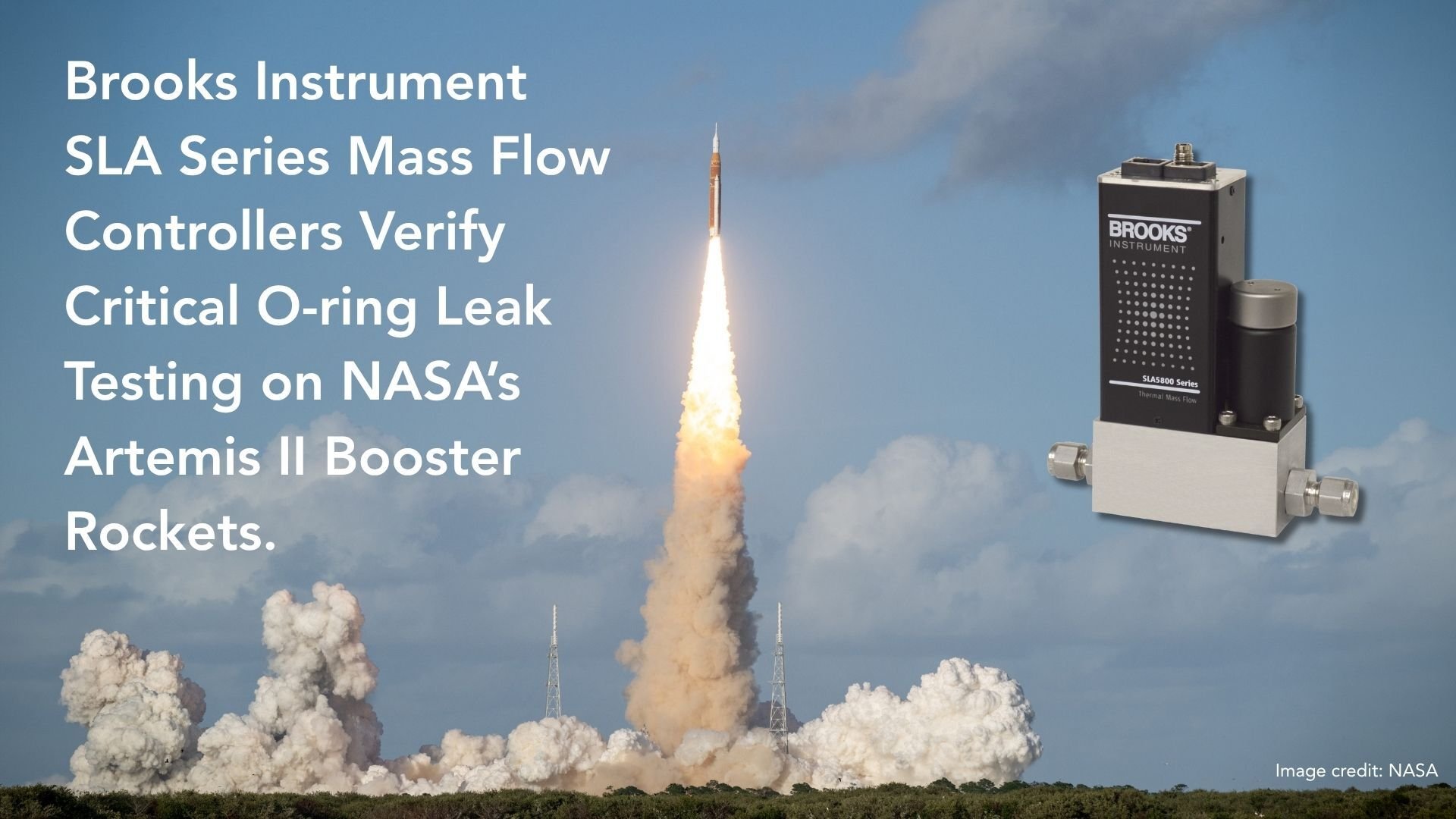
In NASA’s Artemis missions, Brooks SLA Series mass flow controllers are used for critical O-ring leak testing of booster rockets. These systems verify that seals prevent any unintended flow past designated thresholds, ensuring the integrity of propulsion systems during launch.
Key Benefits:
- Accurate low flow measurement
- High repeatability for validation testing
- Reliable detection of extremely small leaks
International Space Station: Life-Support Systems
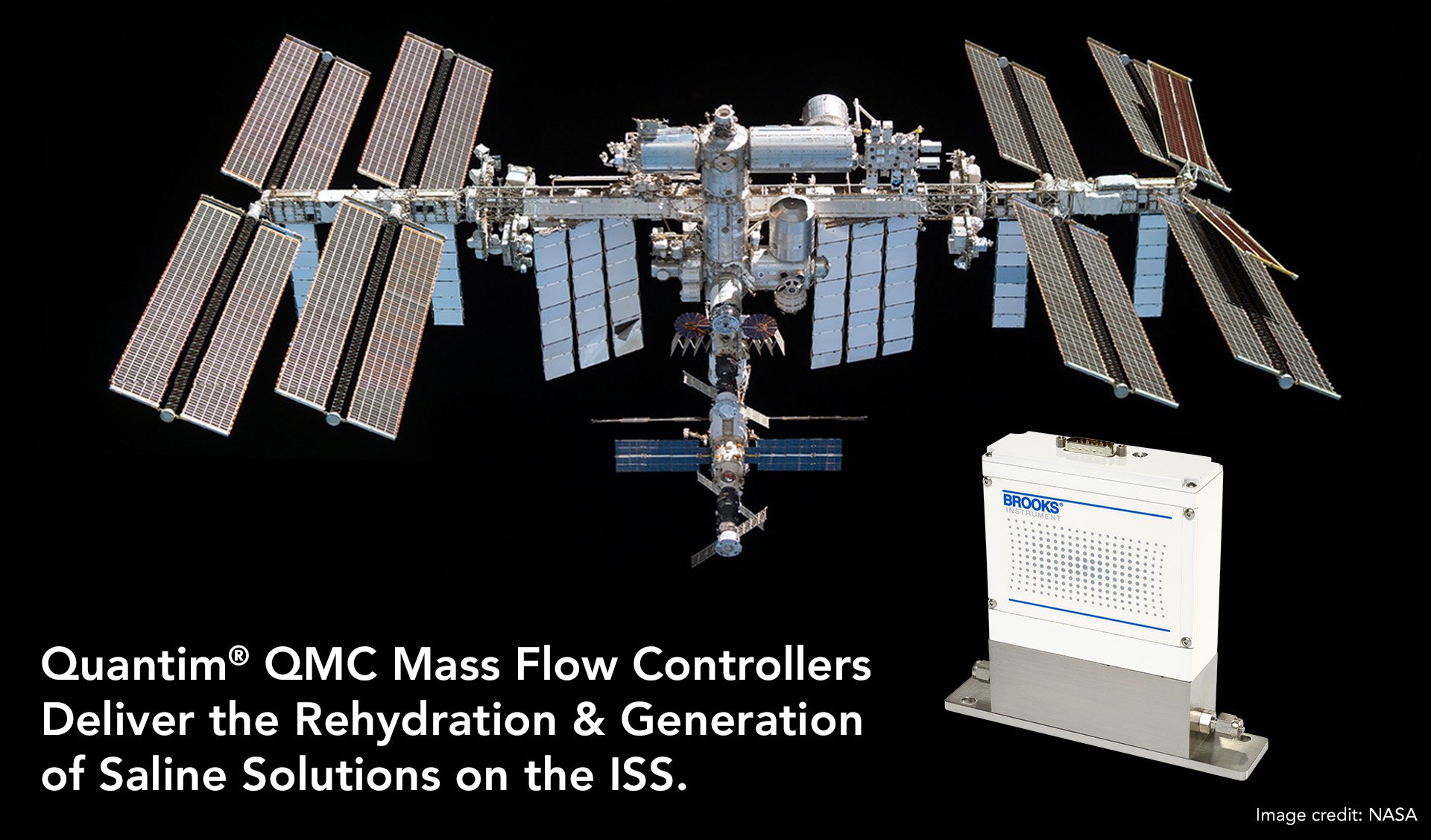
On the International Space Station (ISS), the Quantim® Coriolis mass flow controller supports the rehydration and generation of saline solution, enabling astronauts to receive intravenous fluids on demand.
Key Benefits:
- Precise mass flow control of fluids
- Compact and reliable operation in microgravity
- Support for critical life-support functions
Space Shuttle Program: Enhanced Safety Systems
Following the Challenger accident, NASA implemented enhanced leak detection systems for the Space Shuttle Solid Rocket Motor (SRM). A Brooks Instrument thermal mass flow meter was incorporated into the improved system to ensure more reliable detection of O-ring seal integrity.
Key Benefits:
- Improved safety through enhanced leak detection
- Proven reliability in critical aerospace systems
- Contribution to redesigned validation protocols
Gemini and Apollo Programs: Spacesuit Leak Testing
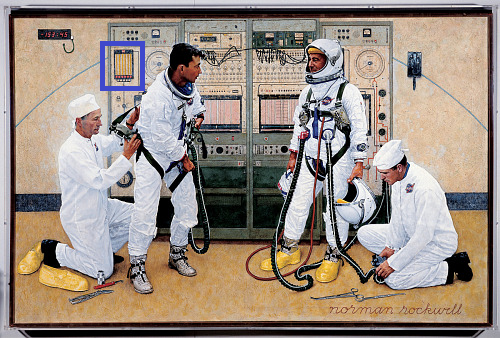
Brooks’ legacy in space exploration dates back to the 1960s, when Sho-Rate® variable area flow meters were used to leak-test NASA spacesuits during the Gemini and early Apollo programs.
These instruments are visible in archival imagery, including a 1962 Norman Rockwell painting depicting astronauts Virgil Grissom and John Young during Gemini mission preparation. The presence of Brooks instrumentation highlights its role in ensuring astronaut safety from the earliest days of human spaceflight.
Key Benefits:
- Reliable visual flow indication
- Proven performance in early aerospace testing systems
Proven Performance in Mission-Critical Environments
Brooks Instrument solutions are designed to deliver:
- Accurate low flow measurement at critical thresholds
- Repeatable control for validation and testing processes
- Long-term reliability in demanding aerospace conditions
As demonstrated across decades of NASA missions, these capabilities are essential where failure is not an option.
|
Conclusion
From spacesuit testing in the Gemini era to O-ring validation in Artemis missions, Brooks Instrument continues to provide the low flow accuracy and repeatability required for mission-critical space systems. Its technologies remain an integral part of advancing human space exploration - supporting both safety and innovation beyond Earth.